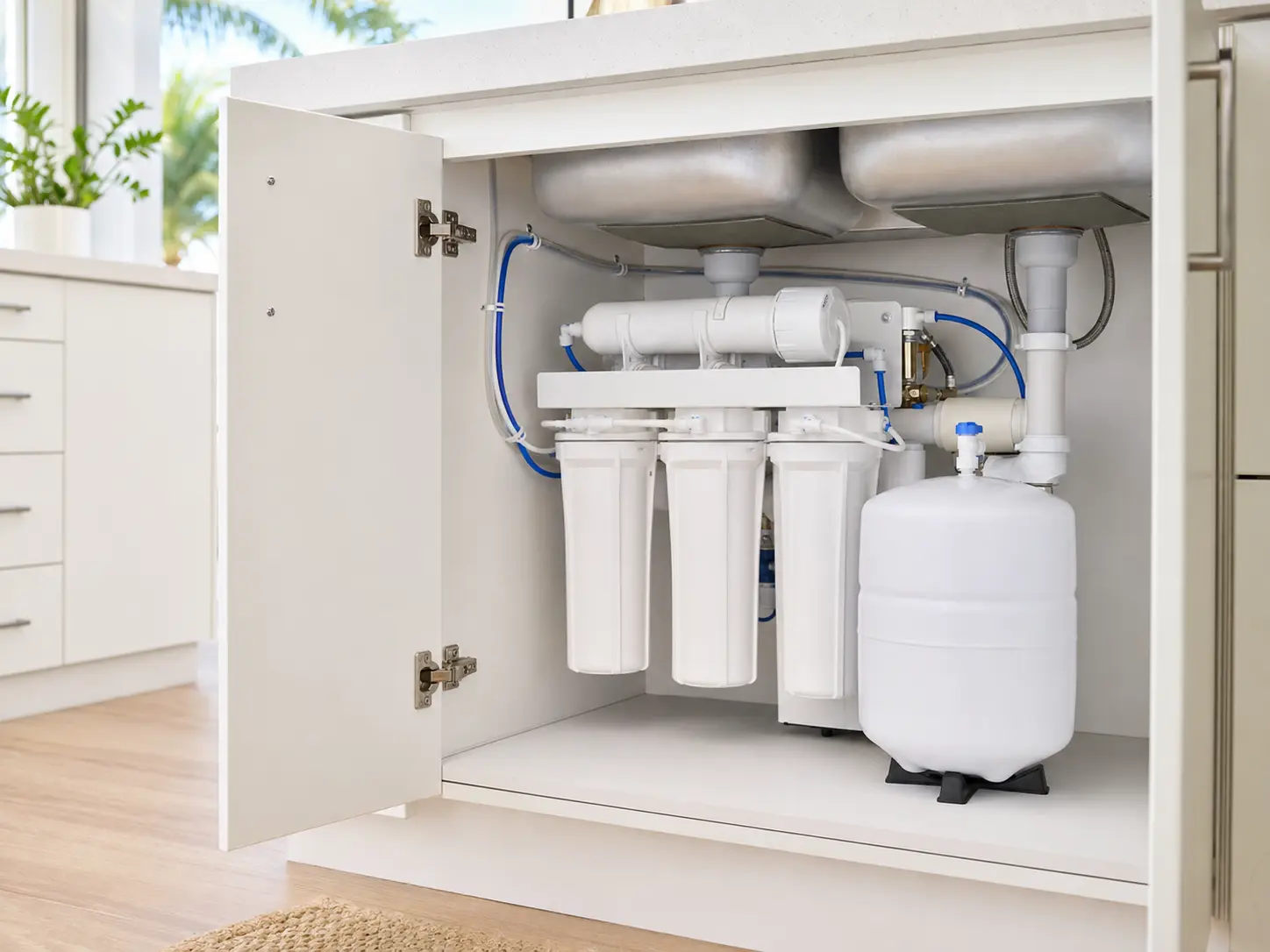
An RO maintenance schedule protects water quality, production rate and membrane life. The correct interval is the one published for your model and adjusted for actual feed-water conditions and use.
Do not rely on a generic rule if the manufacturer specifies a different schedule.
Sediment prefilter
The sediment stage captures particles that could load the carbon stage or membrane. Discoloration alone does not precisely measure remaining capacity, but restriction is a warning sign.
Use the exact micron rating and compatible replacement specified for the system.
Carbon prefilter
Carbon protects the membrane from disinfectants and improves taste. Allowing it to exhaust can shorten membrane life.
Replacement interval depends on capacity, water use and disinfectant exposure.
RO membrane
The membrane usually lasts longer than prefilters. Declining rejection performance, unusually slow production or persistent taste issues can justify testing and diagnosis.
A technician can compare feed and product-water measurements while accounting for pressure and temperature.
Postfilter and remineralization stages
Postfilters are commonly replaced on a routine schedule because they contact water after the storage tank. Remineralization cartridges have their own capacity and should not be treated as permanent.
Use only compatible components to avoid flow or sealing problems.
Sanitation, tank pressure and leak checks
Periodic service is an opportunity to sanitize appropriate components, verify storage-tank air pressure and inspect fittings.
Follow the manufacturer’s procedure; improper chemicals or pressure can damage the system.
Common questions
Frequently asked questions
How do I know the membrane is failing?
Measure performance rather than judging only by taste. A qualified test compares feed and product water under appropriate pressure and temperature conditions.
Can I change RO filters myself?
Many systems are serviceable by homeowners, but correct parts, sanitation and leak testing are essential. Professional service may be preferable for unfamiliar systems.
Why is my RO faucet slow?
Possible causes include low feed pressure, a loaded prefilter, storage-tank pressure, membrane condition or a kinked line.