Reverse osmosis and whole-home filtration are not competing versions of the same product. One treats drinking water at a specific faucet; the other treats water before it moves throughout the house.
The best choice depends on which fixtures you want to treat and what you want the system to reduce. Many households use both, but each should earn its place based on a clear goal.
How reverse osmosis works
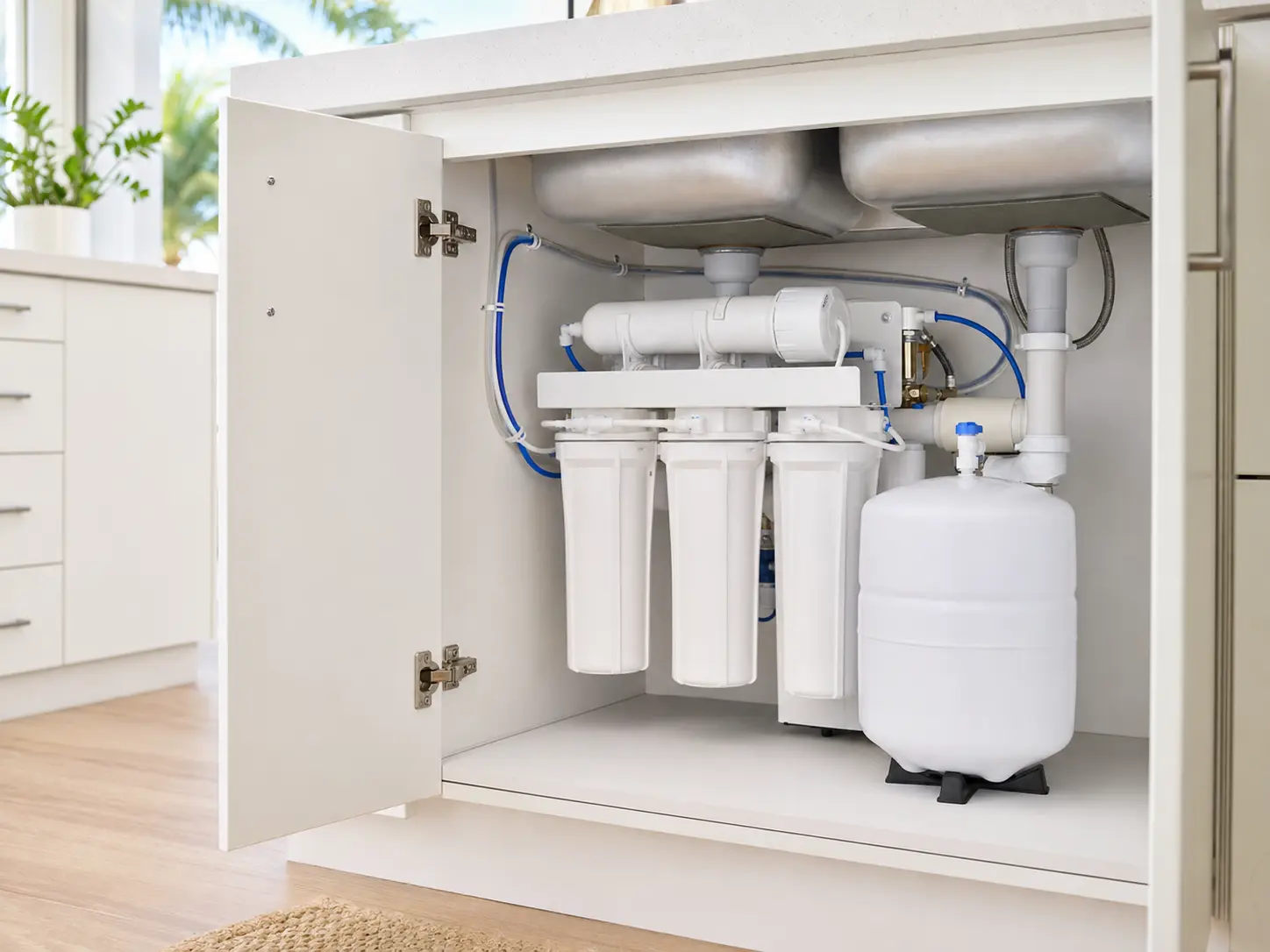
An under-sink RO system normally combines sediment and carbon prefilters with a semipermeable membrane and a final polishing stage. Treated water is stored in a small tank or produced by a tankless unit and delivered through a dedicated faucet.
Because the system treats a limited flow, it is practical for drinking, cooking and sometimes a refrigerator line. It is not designed to supply every shower and appliance in the home.
How whole-home filtration works
A point-of-entry system is installed on the main water line. All downstream fixtures receive treated water, so equipment must be sized for peak household flow without creating an unacceptable pressure drop.
Whole-home carbon systems are commonly configured around chlorine or chloramine taste and odor, but performance depends on media type, tank size, contact time and documented claims.
What each system does—and does not do
RO can reduce many dissolved substances at the connected faucet when properly maintained. Whole-home carbon can treat substantially more water, but it does not perform the same broad dissolved-solids reduction as an RO membrane.
Neither system should be assumed to soften water. If spots and scale are the main complaint, evaluate hardness and a dedicated softener.
- Choose RO for a dedicated drinking-water faucet.
- Choose whole-home carbon for taste and odor at showers, sinks and laundry.
- Add a softener for measured hardness and scale.
- Combine systems only when you have multiple treatment goals.
Installation and maintenance differences
RO needs under-sink space, a cold-water connection, drain connection and faucet location. Whole-home equipment needs access to the main line, adequate floor space, a bypass and room for future service.
RO prefilters and membranes follow a replacement schedule. Whole-home carbon media lasts longer but eventually requires replacement. Maintenance cost should be part of the buying decision.
A simple decision framework
List your complaints by fixture. If the issue is the water you drink, start with RO. If it affects showers and the entire property, investigate point-of-entry treatment. If the issue is scale, test hardness.
Then compare certified performance, serviceability, realistic household flow and the full installed price—not simply the number of filter stages.
Common questions
Frequently asked questions
Do I need both RO and a whole-house filter?
Not always. They solve different problems. Many homes combine them when they want treated water throughout the house plus more intensive filtration at the kitchen faucet.
Does whole-home filtration remove hardness?
Standard carbon filtration does not remove hardness minerals. A traditional ion-exchange softener is a separate treatment stage.
Can reverse osmosis supply my refrigerator?
Often, yes, if the refrigerator is compatible and the tubing route, pressure and distance are appropriate. The plumbing layout should be reviewed first.