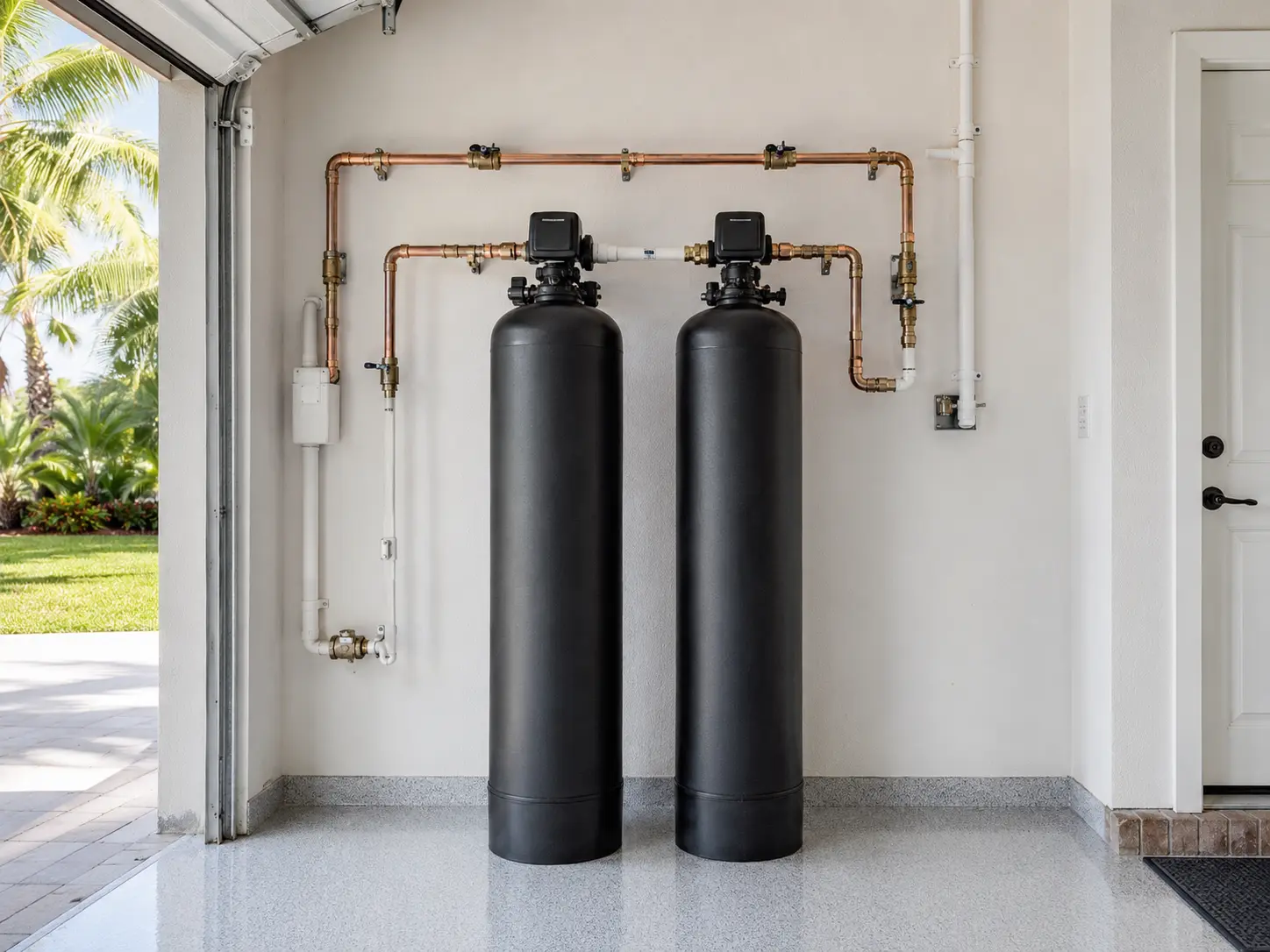
A water softener is useful when hardness minerals are creating a problem you actually want to solve. It is not a universal requirement, and it is not the same as a whole-home carbon filter.
The best decision starts with measured hardness, household demand and your tolerance for spotting, scale and salt-based maintenance.
Common signs of hard water
Hardness often shows up as white mineral deposits rather than an unusual taste. Shower glass, faucets, kettles and water-heater components can reveal the pattern.
Soap performance and skin feel are subjective, so visible scale plus a hardness test gives a more reliable basis for choosing equipment.
- White scale on fixtures
- Persistent spotting on glassware
- Mineral film on shower doors
- Scale in kettles or around appliance connections
How ion-exchange softening works
A traditional softener passes water through resin that exchanges calcium and magnesium ions for sodium or potassium ions. The resin is periodically regenerated with a brine solution.
Metered valves regenerate based on calculated capacity and water use. Correct programming helps control salt and water consumption.
How to size a softener
Sizing considers hardness, iron when relevant, daily water consumption and desired time between regenerations. Oversizing can be wasteful; undersizing can produce frequent regeneration or hardness breakthrough.
The plumbing connection, drain route, power access and space for salt loading also affect the installation.
What a softener will not do
A softener is not a comprehensive contaminant filter. It does not replace carbon media for disinfectant taste and odor, and it does not deliver the same point-of-use treatment as an RO membrane.
If you have multiple goals, the order and compatibility of each treatment stage should be planned as one system.
When a softener may not be worth it
If testing shows modest hardness and you do not experience scale or spotting, the maintenance may not justify the purchase. Some homeowners also prefer not to manage salt or brine discharge.
Define the problem, verify the number and compare conventional softening with alternatives before committing.
Common questions
Frequently asked questions
Can a water softener remove chlorine?
A standard ion-exchange softener is designed for hardness, not chlorine. Carbon filtration is the more common treatment method for chlorine-related taste and odor.
How often do I add salt?
It depends on hardness, tank capacity, valve settings and household use. A correctly sized metered system should regenerate based on actual demand.
Will a softener make water feel slippery?
Softened water can feel different because soap rinses and lathers differently without hardness minerals. Settings and personal preference influence the experience.