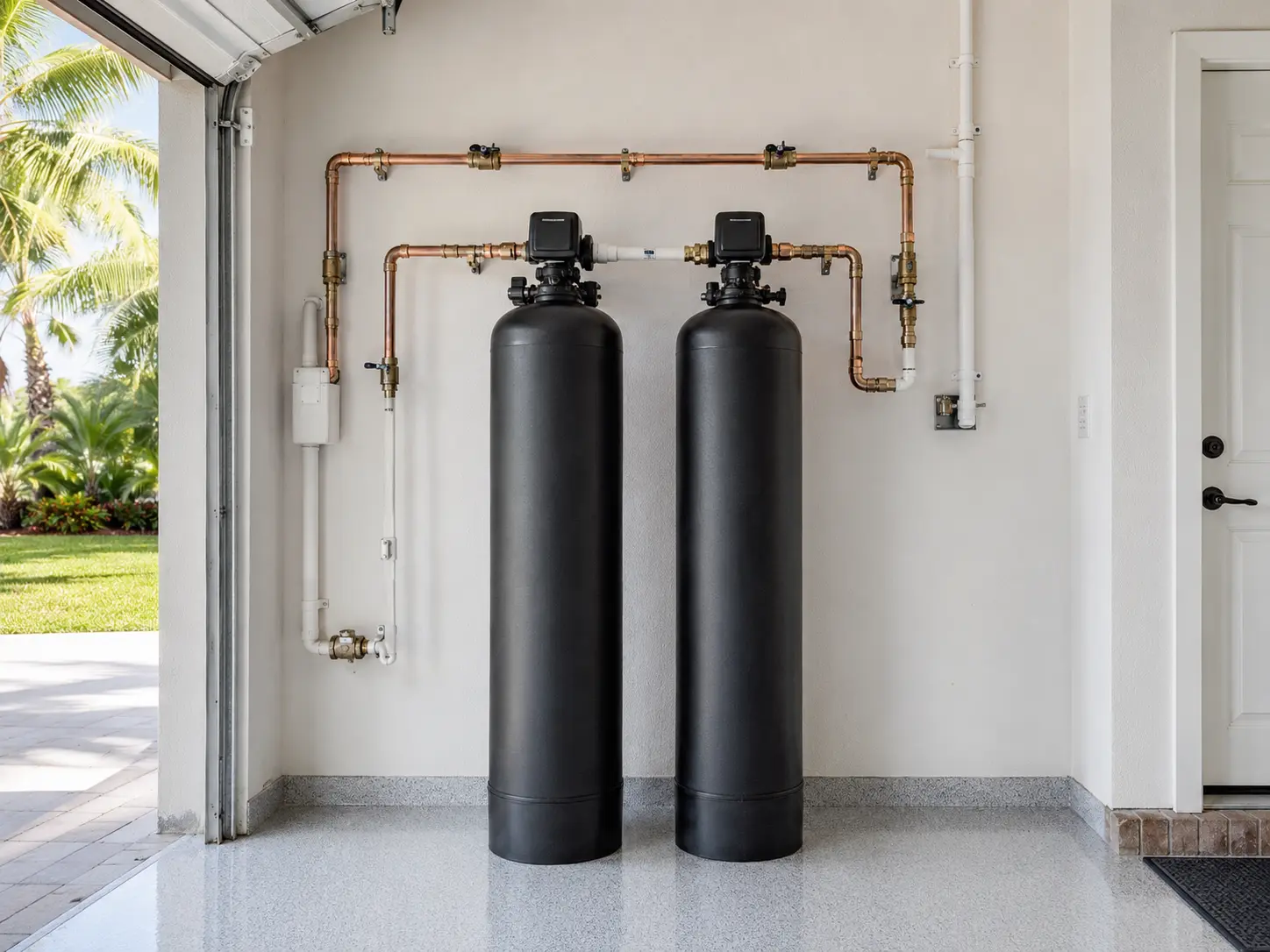
The phrase 'salt-free softener' creates confusion because most salt-free systems do not soften water in the ion-exchange sense. They are generally conditioners intended to influence scale behavior while leaving calcium and magnesium in the water.
Choose between them based on measured hardness, the result you expect and the maintenance or discharge constraints at your property.
Traditional salt-based softening
Ion-exchange resin removes hardness minerals and periodically regenerates with brine. This changes measured hardness and typically provides the most predictable reduction in spotting and scale.
It requires salt, drain access and appropriate programming.
Salt-free conditioning
Salt-free technologies vary. Some use template-assisted crystallization or other media intended to change how minerals form deposits.
Because the minerals remain, a hardness test may show little or no reduction. Expectations should focus on the manufacturer’s verified scale-control claim.
Maintenance and plumbing considerations
A softener needs brine management and regeneration discharge. A conditioner may avoid salt and wastewater but still requires media replacement and adequate flow.
Both need correct sizing, a bypass and service access.
Which one is right for your home?
Choose traditional softening when the goal is measurable hardness removal and the site supports brine discharge. Consider conditioning when salt or drainage is impractical and scale management—not soft water—is acceptable.
Ask the seller to state clearly whether the proposed system removes hardness or conditions minerals.
Common questions
Frequently asked questions
Does a salt-free system make water soft?
Most salt-free conditioners do not remove hardness minerals, so they are not equivalent to ion-exchange softening.
Will salt-free treatment stop all spots?
No system should promise that without qualification. Minerals remain in conditioned water and can still be visible when droplets evaporate.
Does softened water contain salt?
A softener exchanges ions; it does not add table salt to the water. The amount of sodium added depends on the hardness removed.